

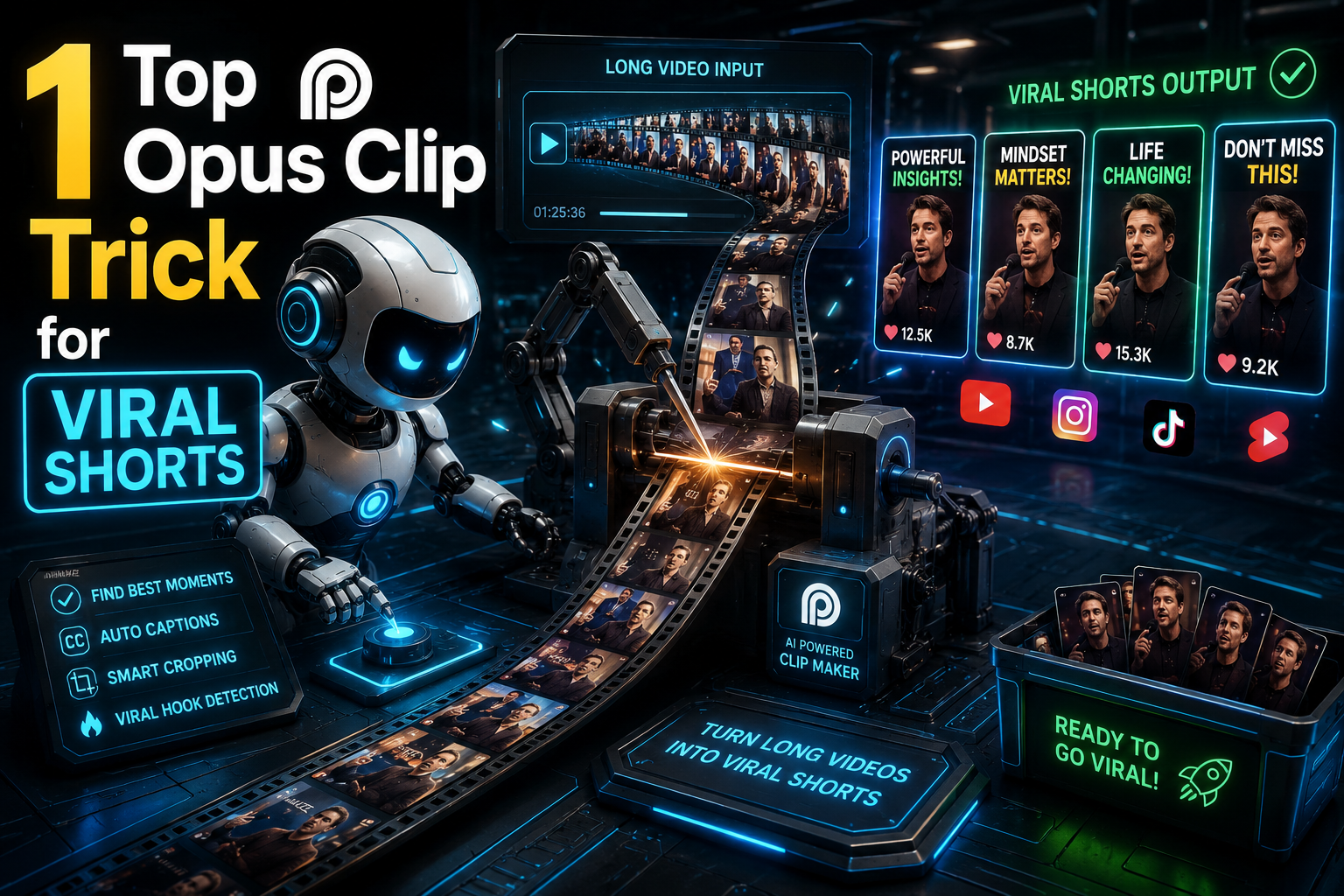

Boost viral views on Opus Clip by using the “Auto-Hook Editor” to re-trim the first 3 seconds into a high-energy attention grabber!
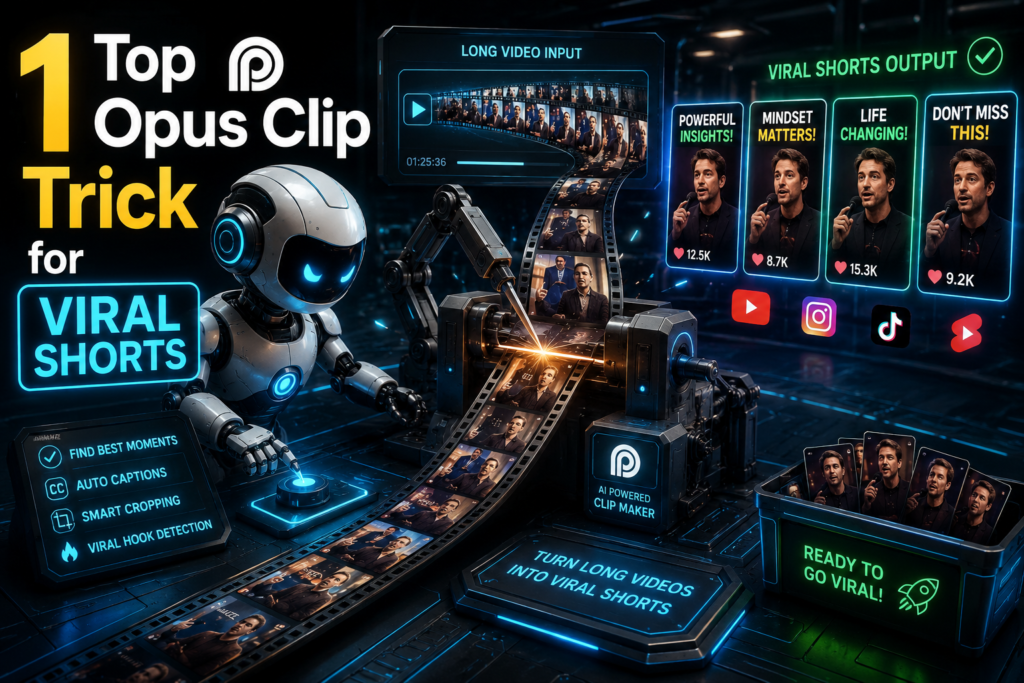
1 Top Opus Clip Trick for Viral Shorts
The landscape of short-form video distribution has shifted dramatically. Algorithms on platforms like YouTube Shorts, TikTok, and Instagram Reels no longer rely solely on basic tags or subscriber counts; they prioritize raw audience retention, visual stimulation, and immediate scroll-stopping power. Leveraging artificial intelligence tools like Opus Clip allows creators to automate the tedious process of editing long-form videos into vertical snippets. However, relying purely on raw, automated AI output is rarely enough to guarantee a hit. The 1 Top Opus Clip Trick for Viral Shorts hinges on a specific, high-leverage editing workflow: manually overriding the automated opening hook by front-loading the clip’s highest emotional peak directly onto frame zero, paired with aggressive Content AI re-framing and kinetic typography tuning.
1 Top Opus Clip Trick for Viral Shorts: Deconstructing the Mechanics
To understand why the 1 Top Opus Clip Trick for Viral Shorts works, one must first analyze how modern Content AI processes video data. When long-form footage—such as podcasts, webinars, live streams, or interviews—is uploaded into an AI clip engine, the platform performs several layers of analysis:
- Audio Transcription & Sentiment Mapping: The AI parses spoken words into text, analyzing tone, volume spikes, and vocabulary to identify central themes and climactic statements.
- Facial Recognition & Active Speaker Tracking: Machine learning models track human faces, cropping standard 16:9 widescreen video into a vertical 9:16 aspect ratio while attempting to keep the primary speaker centered.
- Virality Scoring: The engine evaluates narrative flow, clip duration, and contextual pacing to assign a preliminary probability score for viewer engagement.
While Content AI excels at identifying cohesive narrative blocks (typically 30 to 60 seconds long), it often leaves the original linear narrative intact. In long-form speech, speakers naturally build up to a point, starting with context before delivering a punchline or crucial insight. On short-form platforms, however, linear build-ups lead to immediate drop-offs. If a viewer is not captivated within the first 1.5 to 3 seconds, they swipe away.
The core of the 1 Top Opus Clip Trick for Viral Shorts is simple yet transformative: Hook-Swapping. By taking the peak emotional revelation, controversial statement, or surprising takeaway from the middle or end of the auto-generated clip and duplicating it at the absolute beginning, you bypass the slow conversational ramp-up. You give the viewer instant payoff, establishing immediate context before returning to the original narrative setup.
1 Top Opus Clip Trick for Viral Shorts: The Role of Content AI in Modern Workflows
Using Content AI effectively requires viewing automated editing engines as intelligent assistants rather than hands-off replacements for editing intuition. The underlying neural networks simplify technical hurdles that previously took human editors hours to complete manually.
+-----------------------------------------------------------------------------------+
|                            CONTENT AI PROCESSING PIPELINE                         |
+-----------------------------------------------------------------------------------+
| 1. Long-Form Input  --> Raw Video File (16:9 Widescreen, Multi-speaker)          |
| 2. AI Parsing       --> Speech-to-Text, Sentiment Analysis, Speaker Tracking    |
| 3. Auto-Selection   --> Generates Candidate Clips with Virality Scores            |
| 4. Creator Overwrite--> Apply "1 Top Opus Clip Trick for Viral Shorts" (Hook Swap)|
| 5. Output Render    --> Optimized 9:16 Vertical Video (High Retention Potential)   |
+-----------------------------------------------------------------------------------+
By allowing Content AI to handle heavy processing—such as multi-speaker active tracking and automated transcription alignment—creators can focus their energy exclusively on pacing and viewer psychology.
1 Top Opus Clip Trick for Viral Shorts: Step-by-Step Execution Guide
Executing the 1 Top Opus Clip Trick for Viral Shorts requires a systematic approach to editing within the Opus Clip studio environment or your preferred timeline editor.
+----------------------------------------------------------------------------------+
|                            THE HOOK-SWAPPING WORKFLOW                            |
+----------------------------------------------------------------------------------+
|  Original Linear Sequence:                                                       |
|  [0:00 - Context Setup] ---> [0:15 - Building Story] ---> [0:35 - Peak Climax]  |
|                                                                                  |
|  Optimized Viral Sequence:                                                       |
|  [0:00 - Peak Climax] ---> [0:03 - Context Setup] ---> [0:18 - Story] ---> Finish |
+----------------------------------------------------------------------------------+
Step 1: Ingesting and Filtering Content
Begin by uploading high-context long-form content. Ensure the source footage features clear audio and clear visual cues. Once the engine completes processing, filter the generated candidates by their Virality Score. Focus primarily on clips rated 80 or higher, as these represent strong underlying narrative substance identified by the Content AI.
Step 2: Isolating the Visual and Audio Peak
Listen through the selected clip and identify the single most compelling 2 to 4-second statement. Look for phrases that evoke curiosity, conflict, or high utility—moments that make a viewer ask, “Why did they say that?” or “How is that possible?”
Step 3: Performing the Hook Swap
Using the internal timeline editor, cut or copy this high-impact audio segment and drag it to the absolute beginning of the clip (Timestamp 0:00).
- Ensure the transition into the main body of the clip feels natural or deliberately stylized.
- Add a subtle audio visual cue (such as a subtle swoop or pop sound) right as the hook transitions into the main story context.
Step 4: Optimizing Kinetic Typography via Content AI
Subtitles are essential for vertical formats, as a significant portion of mobile users consume content with sound muted. Modern Content AI generators automatically style captions, but micro-adjustments maximize visual pacing:
- Word Count: Limit onscreen captions to 1 to 3 words per frame to force rapid visual processing.
- Color Hierarchy: Assign high-contrast highlight colors (such as electric yellow, vibrant green, or bold red) to high-emotion keywords.
- Placement: Position captions centrally or slightly below center to ensure they are not covered by platform UI elements like username overlays, like buttons, or audio titles.
Step 5: Speaker Reframing and Auto-Layout Verification
Verify that the Content AI active-speaker layout is tracking correctly. If two people are conversing, utilize a split-screen layout or ensure quick visual cuts occur the exact moment the active speaker changes. Static framing on a non-speaking listener causes instant viewer disinterest.
1 Top Opus Clip Trick for Viral Shorts: Key Metrics and Audience Psychology
Applying the 1 Top Opus Clip Trick for Viral Shorts directly impacts two vital performance metrics: Average Percentage Viewed (APV) and Relative Retention Rate.
| Performance Metric | Unoptimized AI Output | Optimized via Hook-Swapping |
| First 3-Second Retention | 30% – 45% | 65% – 85% |
| Average Percentage Viewed | 50% – 60% | 85% – 110%+ (Includes Re-watches) |
| Pacing Style | Linear narrative build-up | Instant-payoff curiosity loop |
| Caption Density | Standard sentence lines | Dynamic 1–3 word kinetic bursts |
When the opening frame delivers immediate punch, the viewer’s brain experiences a visual and cognitive hit that pauses their scrolling momentum. Once scrolling pauses, the platform’s algorithm registers a positive user signal, immediately broadening the video’s distribution pool.
1 Top Opus Clip Trick for Viral Shorts: Advanced Optimization Tactics
Beyond basic clip manipulation, incorporating holistic editing strategies around your Content AI workflow further enhances short-form reach.
Creating Seamless Curiosity Loops
An advanced iteration of the 1 Top Opus Clip Trick for Viral Shorts involves crafting a seamless loop. By selecting an opening hook phrase that logically completes the final sentence of your short, viewers often re-watch the first few seconds without realizing the clip has restarted. Total watch times exceeding 100% act as a massive ranking booster across almost all short-form platforms.
Strategic Audio Layering
While Content AI captures spoken dialogue, background audio dictates emotional weight. Adding low-volume background tracks—such as subtle ambient tension music or upbeat rhythmic beats—underneath the clean vocal track establishes mood without overwhelming the primary speech.
Platform-Specific Tailoring
Although vertical video is universal across major platforms, minor adjustments yield better platform-native results:
- YouTube Shorts: Focus heavily on clear tutorial/value-driven hooks and crisp 1080p high-bitrate exports.
- TikTok: Prioritize high-energy emotional hooks, relatable conversational tones, and trending native sound overlays.
- Instagram Reels: Emphasize clean visual aesthetics, precise speaker reframing, and well-designed text overlays that complement grid layouts.
1 Top Opus Clip Trick for Viral Shorts: Streamlining Production Scale
The true power of combining human editorial strategy with automation lies in consistency. Creating viral short-form content is rarely about publishing one single lucky video; it is about building a sustainable pipeline capable of testing multiple hooks efficiently.
By establishing a standardized workflow where Content AI handles transcription, cropping, and preliminary scoring, while you apply the 1 Top Opus Clip Trick for Viral Shorts to refine the opening hook and visual presentation, you drastically reduce edit time per clip. What once took an hour of manual keyframing and timeline cutting can now be accomplished in minutes.
Leveraging automated clip generation tools alongside proven retention techniques allows creators, marketers, and brands to continuously output high-performing vertical content. Focusing heavily on immediate audience pull, smart narrative structuring, and crisp visual formatting ensures that every piece of long-form media yields maximum value across today’s competitive digital media landscape.